


Welcome to Sino Agro, One-stop Solution for All Your Agricultural Chemical Needs.

Products
To ensure every grower has knowledge that adds value and contributes
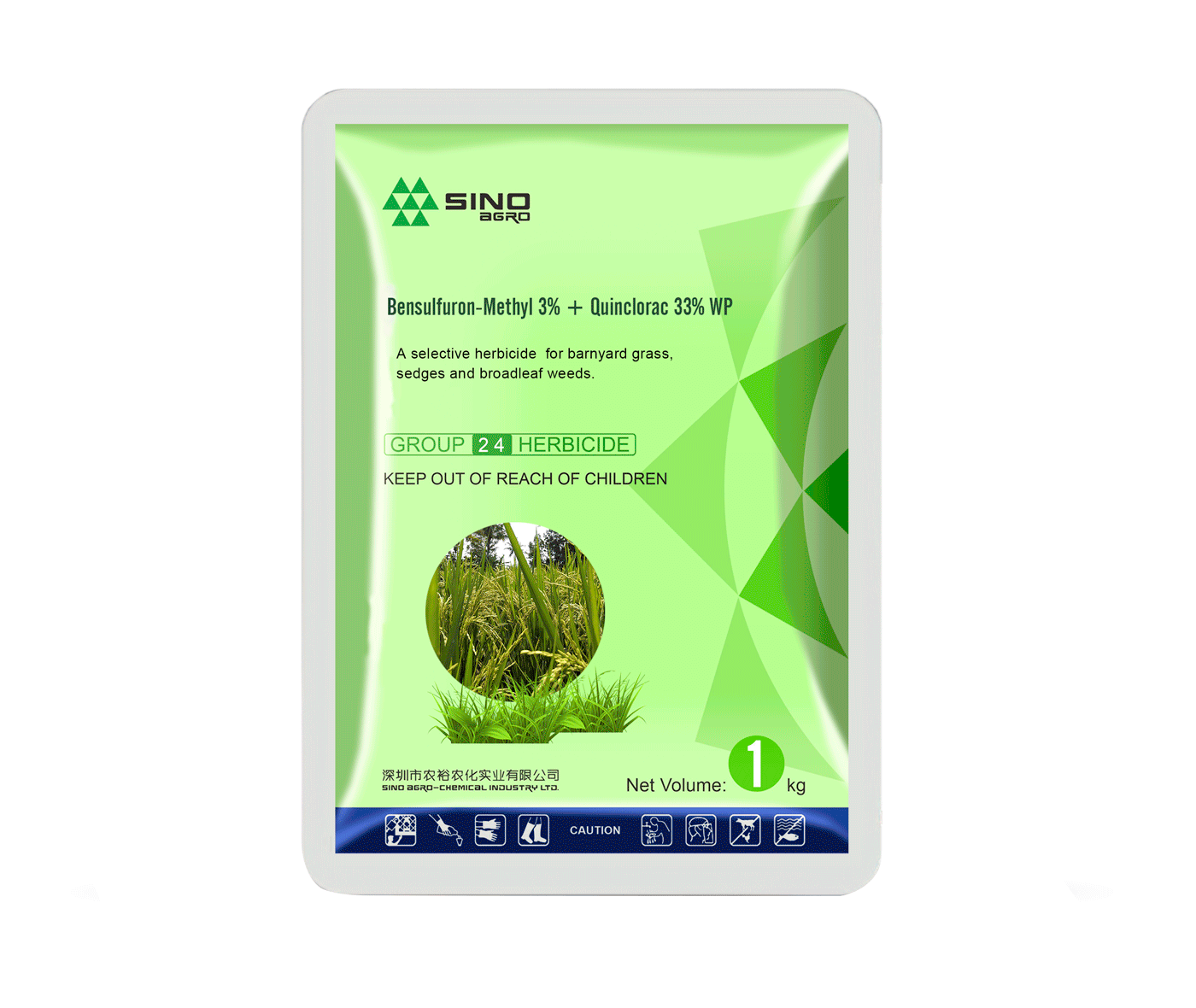
Bensulfuron-methyl 3% + Quinclorac 33% WP
Formulation:
Bensulfuron-methyl 3% + Quinclorac 33% WP
CAS NO:
83055–99–6 + 84087–01–4
USAGE:
control annual and perennial broad-leaved weeds and sedges in rice seedling fields, direct seeding fields and transplanted fields.
Pack size:
100g, 250g, 500g, 1kg, 25kg/bag or as required

24H
Response Time
100%
Response Rate




Direction for Use
|
Crop |
Target Disease |
Dosage |
Application Timing |
Remarks |
|---|---|---|---|---|
|
Paddy rice fields |
annual and perennial weeds |
900-1200g/ha |
2.5 leaf stage to early tiller of rice; 3-4 leaf stage of barnyard grass |
1) REI: 12 hours |

Product details
 Mode of Action
Bensulfuron-methyl is selective, systemic action being absorbed through foliage and roots. Inhibits plant amino acid synthesis - acetohydroxyacid synthase AHAS.
Quinclorac acts as an auxin mimic and is classified as a quinolone carboxylic acid. It is absorbed by the foliage and translocated throughout the plant. Symptoms exhibited by broadleaf weeds include leaf and stem curling or twisting, and necrosis. Susceptible grasses show signs of stunted growth, chlorosis (whitening) and slow reddening followed by necrosis and death.
 Benefits
1. Selective pre- and post-emergence control of annual and perennial weeds and sedges, grass weeds and other weeds in flooded or wetland rice, in direct-seeded and transplanted rice.
2. Gives control for a longer time. It is safe to rice crop as compared to other weedicides used in this crop.
High mobility in soil, degraded by micro-organisms.
 Precautions
1. This product is very sensitive to umbelliferaceae crops, such as carrot, celery and coriander, etc., and the drifting objects of the pesticide liquid may cause phytotoxicity to these crops in adjacent fields.
2. Do not eat, drink or smoke while handling this product or before washing and changing clothing after use.
Avoid contamination of food, feeds, drinking water, eating utensils, seed, fertilizer and other agricultural chemicals.
Environmental Hazards
Keep out of lakes, ponds and streams. DO NOT apply directly to water, to areas where surface water is present, or to intertidal areas below the mean high-water mark. DO NOT contaminate water by cleaning of equipment or disposal of rinsate. This chemical has properties and characteristics associated with chemicals detected in groundwater. The use of this chemical where soils are permeable, mainly where the water table is shallow, may result in groundwater contamination.
Keyword:
Recommended











Do you have any questions?
We are here to help!
Send a message or speak to SINO AGRO about your need and you shall certainly have the right feedback.
Need Help :
-
Business Center:
-
No. 2030, Jintian Road, Futian District, Shenzhen, China
-
Email:
-
consultant@sinoagrochem.com.cn
CopyRight © 2023-2034 SINO AGRO-CHEMICAL INDUSTRY LTD. All Rights Reserved.
APVMA
IRAC
FRAC
HRAC
EFSA
CIPAC
EPA
FAO